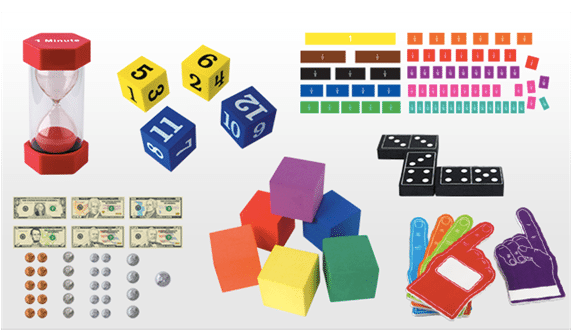
While the idea of using manipulatives during math instruction has been around for a long time, this movement has picked up steam in recent years. There are varied opinions on the topic, so this blog was created to weigh the pros and cons of manipulatives in the math classroom. General findings will also be discussed.
As a future educator, I have personal experiences with working with manipulatives that I would like to share with all of you! The sharing of these experiences will help spread knowledge throughout the educator community and make us all better teachers.
What are Manipulatives?
- Concrete objects that students can physically “manipulate” to help them solve a problem
- Used by students to demonstrate or model abstract concepts
- Objects used as manipulatives do not have to strictly be used for mathematical use (any item can be used as a manipulative)
Examples of Commonly Used Manipulatives
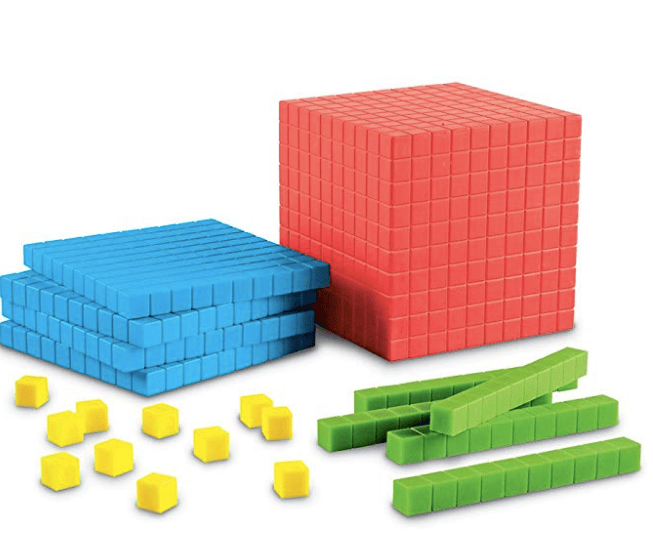
- Thousands, Hundreds, Tens, and Ones Blocks: These manipulatives are almost always used to teach addition and subtraction. They can also be used to introduce place value .
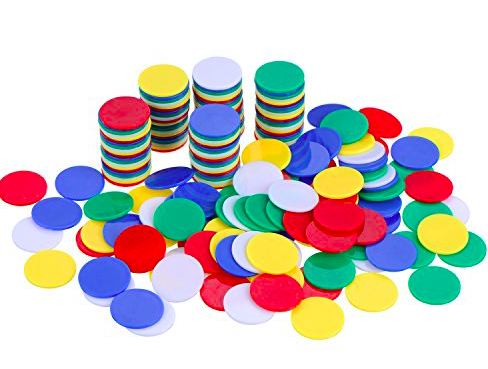
2. Counter Chips- These colorful chips can be used for a variety of different math lessons. I have seen them commonly used to make ten frames, map out simple addition and subtraction problems, and to make arrays.
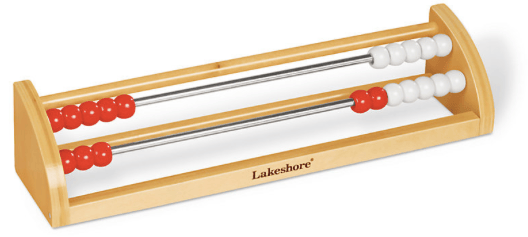
3. Rekenrek- This manipulative can be used to help students map out addition and subtraction facts. It can also be very helpful to use when solving word problems as well.
Pros and Cons of Using Manipulatives in Your Classroom
Here are some of the most common pros and cons found on using manipulatives in the math classroom:
Pros:
1. helps to teach important skills, 2. allows students to visualize what they are working on, 3. hands-on experience in the classroom, 4. gets students involved, 5. students take on a sense of leadership and control, 6. real application, 7. improves overall understanding
Cons: 1. can be very expensive, 2. must be thoughtfully planned, 3. can be time-consuming, 4. students may “play” with manipulatives, 5. does not work seamlessly with some mathematical topics,
While every educator, student, and classroom environment is different, studies have been shown that the use of manipulatives actually IMPROVES student understanding and achievement in the math classroom. Teachers, especially beginners, are better able to explain difficult concepts effectively and learn alongside their students. In fact, students who worked with manipulatives at the beginning stages of learning were better able to understand abstract algorithms later on during instruction (according to Dr. Annita W. Hunt). Overall, the consensus shows that manipulatives are a very powerful addition in a positive way to the math classroom.
My Personal Experience Using Math Manipulatives

From student teaching in a second grade classroom, I have personally seen how much of a difference a simple manipulative tool can make in the learning process. When manipulatives are involved in a lesson, students seem to become more attentive. It truly gives them an outlet to figure it out on their own and make their thinking concrete. They are better able to map out the information that they know, which will help their achievement later. While some students may take advantage of the manipulatives and move off-track at times, a simple reminder to act appropriately seems to do the trick. Overall, math manipulatives can work wonders with students of any age in the classroom. As an educator, I swear by the use of manipulatives!
Works Cited:
 All About Manipulatives in the Math Classroom